Tag: hypnotherapy

  • What can I do about my anxiety? The 10,000 foot-high view

    What can I do about my anxiety? The 10,000 foot-high view

    Everyone has anxiety sometimes. It’s when the anxiety starts to effect your life that it’s time to do something about it. This is the 10,000 foot-high view of what you can do about it. In broad terms, there are three mainstream ways of dealing with your anxiety:

    1. Self-help techniques – There are a range of techniques that you can learn to do yourself. For example, simply recognising if something is triggering the anxiety and avoiding it, various breathing techniques, and practicing mindfulness are three very different approaches, all of which can help.
    2. Therapy – Different therapies have different approaches to deal with anxiety and will suit different people. Hypnotherapy focuses on getting the subconscious fight-or-flight part of the brain to recognise there is no need to be anxious. Cognitive behavioural therapy (CBT) works on the relationship between thoughts, emotions, behaviours and bodily sensations.
    3. Medication – Prescribed medications can alter your brain chemistry to help dampen the extremes of anxiety.

    If you go to your NHS doctor (in the UK) about your anxiety, they will start by asking you questions about your anxiety, such as how often you feel anxious, and may diagnose you with one of several categories of anxiety (such as generalised anxiety disorder, social anxiety, or obsessive-compulsive disorder).

    Depending on the severity of the anxiety, your doctor will probably offer you advice on self-help techniques. If you don’t get anywhere with self-help, the next step will probably be to offer you and initial course of six sessions of CBT. Finally, if that fails to help, they may prescribe anti-anxiety medication. (All of these may be prescribed by your local surgery or a consultant psychiatrist.)

    The big advantage to UK citizens is that the NHS service is provided free of charge. The disadvantage is that it may take some time to get the service that you need. Another disadvantage is that, unfortunately, hypnotherapy is not yet available on the NHS.

    In my hypnotherapy clinic in Fleet in Hampshire, I regularly see clients with anxiety and anxiety-related issues. I typically find that they can achieve a significant reduction in their anxiety levels with between 5 and 10 hypnotherapy sessions.

    Remember that the questions to ask yourself first are, “Is my anxiety adversely affecting my life? And if so, is it bad enough for me to want to actively do something about it?”

    The next step is to choose which route you are going to take:

    • DIY – Do it yourself — research the Internet for some self-help techniques to try by yourself.
    • NHS — go to your doctor and follow the route described above.
    • Therapist — find a qualified hypnotherapist, CBT therapist or counsellor.
    • Class — find a class in mindfulness, yoga or something else that involves relaxation.

    Or you could try multiple routes at the same time.

    And, of course, I have to include a little promotion for my own hypnotherapy clinic … so if you want a qualified hypnotherapist who specialises in anxiety, just get in touch.


    Photo by Denys Nevozhai on Unsplash

  • Do I have high-functioning anxiety?

    Do I have high-functioning anxiety?

    Do others see you as a high-achiever, calm, well-organised, and getting loads of stuff done? And while you achieve all this, are you secretly worried, with your mind going like the clappers – thinking of all the stuff you have to do, and scared that you might make a mistake somewhere along the line?

    That is high-functioning anxiety – confidently achieving a lot on the outside, but stressed out and worried on the inside – like the swan looking magnificent on the surface, but whose legs are frantically paddling down below the surface.

    High-functioning anxiety is not a medical term. There is no agreed definition. If you go to a doctor, they will probably describe you as having “Generalised Anxiety Disorder” – or GAD for short. GAD is a catch-all term for all sorts of anxiety issues.

    The problem with high-functioning anxiety is that you are running with your stress bucket on full – that is, there is so much stress in your life that just a little more will push you over the edge. We all have stresses in our lives and store them in our (metaphorical) stress bucket. Usually, the stuff in your stress bucket is dealt with naturally during your sleep, but sometimes, there’s just too much there.

    Some people find it a little embarrassing to admit that their external appearance (high achiever, well-organised, involved in everything) is different from their internal feelings (anxiety, worry, tension). And so it can carry on for a long time without getting properly addressed.

    A person with high-functioning anxiety may think that if they do something about their anxiety, they won’t achieve as much – and so they may be scared to actually do something about it. This may stop them seeking help. They may be so busy, that they don’t think they have time to look for help.

    So what is the answer? What can you do if you do think you have high-functioning anxiety?

    It is not simply a case of doing less – there is not a one-to-one correspondence between how much you do and how much anxiety you have. And there is no one-size-fits-all solution … what will work for you will not work for someone else.

    The starting point is to work out what is important to you in your life – where your priorities lie. You also have to make a decision – is my mental health important enough for me to take time out to do something about it. Maybe you can do something for yourself, or maybe it’s a good idea to seek professional advice from someone who can help you.

    A properly qualified hypnotherapist can certainly help, and other therapies may better suit some people. Whatever you decide to do – the first thing is to start.


    Photo by Erik van Dijk on Unsplash

  • The Unconscious Mind

    The Unconscious Mind

    Right now, you are aware of the words that you are reading … you are conscious of them … you are paying (at least some) attention to them. This is the conscious part of your brain in operation – the bit that is aware of what is going on and makes all the main decisions in your life. It is the part of you mind that chose to read this article in the first place.

    We also have a part of the brain that we are not aware of … that part of the brain that just gets on with things. You are probably not aware of the pressure of your back on the back of chair you are sitting on – or, if you are standing, of the pressure of your feet on the floor. That is, you weren’t aware of it until I mentioned it.

    The unconscious part of your brain is busily monitoring the pressure of your back on the back of the chair, and – because there is nothing going wrong – it doesn’t bother to alert the conscious part of the brain, so you don’t think about it.

    The unconscious part of your brain does so much for you without you thinking about. It just gets on and does it. Many years ago, you learned to walk. Now that you are an expert at walking, you don’t need to think, “now move your left leg … next your right.” You just do it. The unconscious part of your mind handles all the details without making you aware of them.

    Now, this is all very well, until we programme some behaviour into the unconscious part of our brain that we don’t actually like. We can accidentally programme our brain into all sorts of unwanted behaviours – like being afraid of spiders, being anxious about social occasions, binge eating, having a craving to smoke, and so on. When the unconscious part of our mind has learned a pattern, it is very difficult to change it. We cannot say to ourselves, “I’m going to stop being anxious now.” And just stop … it doesn’t work like that.

    Hypnotherapy is the art of helping someone get into the right state to allow the unconscious part of their brain to be able to sort itself out on its own. The brain needs the space to sort itself out, and when the right ideas are planted there, and they have space to grow, the brain will, over a period of time, heal itself and get rid of those unwanted thoughts, feelings and behaviours.

    A very important part of hypnotherapy is to reduce the amount of stress you are experiencing. Whenever you are stressed, the unconscious part of your brain is looking out for problems, and so doesn’t have the space to sort itself out – it is too busy getting ready to deal with the problems that may be coming your way.

    So one of the things that a good hypnotherapist will do is to lead you into a nice relaxed state, because when your body and mind are both relaxed, you are able to make the changes you need to make.


    Photo by Milad Fakurian on Unsplash

  • Everyone has anxiety sometimes

    Everyone has anxiety sometimes

    Everyone has anxiety sometimes. The difference is that some people only have fleeting moments of anxiety, maybe once a year … while others have anxiety feelings almost every day. For many people, living with anxiety is so normal to them that they do not realise that it is quite possible to live life with little or no anxiety.

    The big question is: Has your stress and anxiety reached a stage where you want to do something about it? Knowing that you could reduce your anxiety levels and get back in control of yourself, would you actually want to do that? What would your life be like when the anxiety is gone.

    This is not a simple question to answer, because if you do want to do something about it, you need to put some effort in – and there are no miracle cures – it doesn’t change overnight. I tell my clients, “You have spent years training your brain to be anxious, and now it is very good at it. It will not change overnight – but in a few weeks you can make significant changes, once you have decided to put the effort in.”

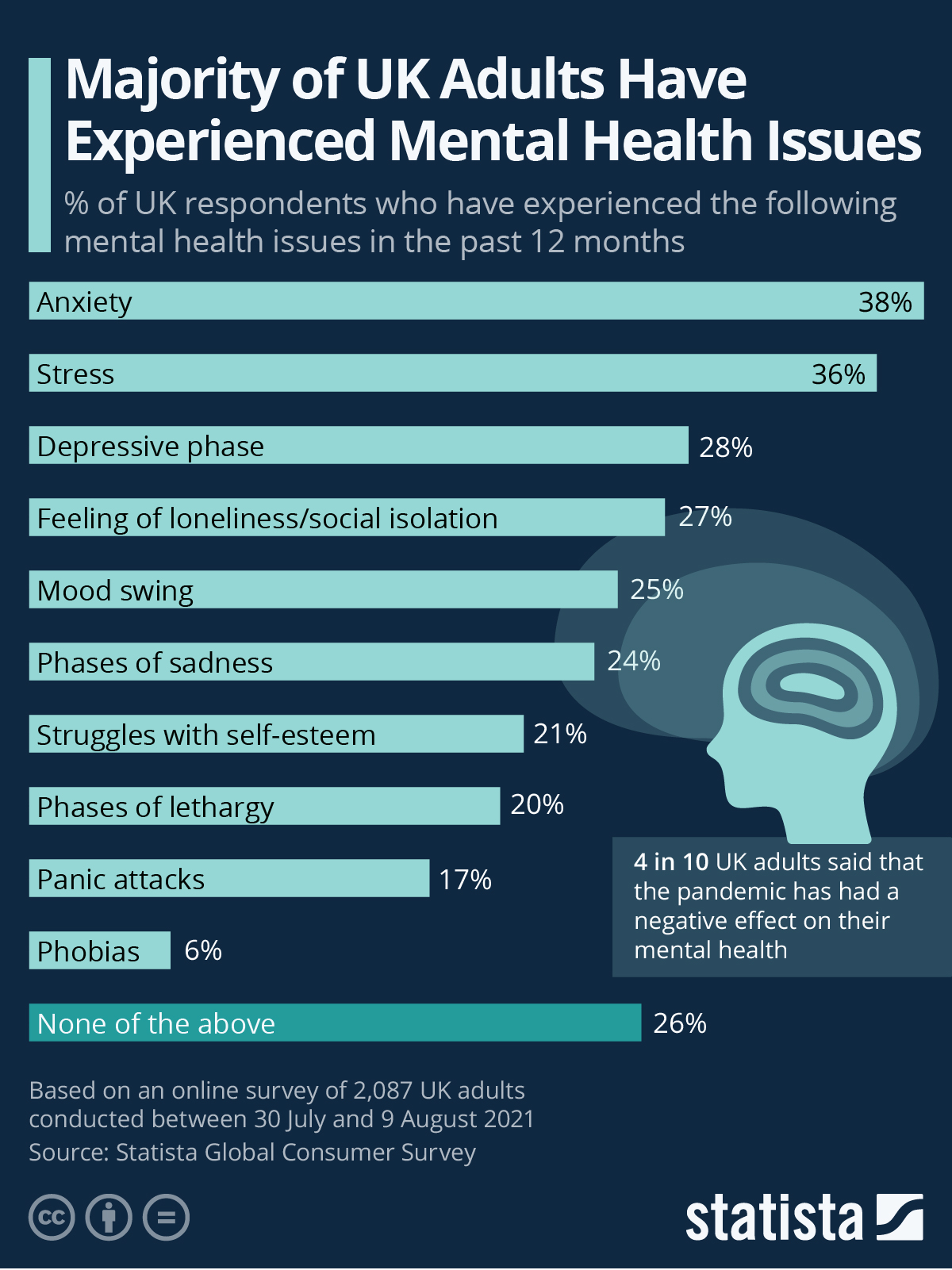
    Infographic: Majority of UK Adults Have Experienced Mental Health Issues | Statista

    So, if you have decided that you want to lead a less anxiety-filled life, what can you do about it? There are basically three main avenues that you can pursue:

    Self-help – there are lots of things that you can do to help yourself, including exercise, mindfulness, taking a positive outlook on life and so on.
    Medication – if you go to your doctor, you may well be prescribed medication to help reduce the anxiety – although the modern trend seems to be to start with therapy first.
    Therapy – there are many types of therapy – hypnotherapy, cognitive behavioural therapy, emotional freedom technique, cuddle therapy and the like.

    I help people who want to reduce their anxiety levels using hypnotherapy. In particular, I concentrate on solution-focused hypnotherapy, which looks at what my clients want to achieve rather than digging up their past. I find that typically within 5 to 10 sessions (see note below), my clients have significantly regained control of themselves and are able to live their lives without the symptoms of the anxiety they used to suffer from.

    Contact me if you want a chat about your anxiety, and what your want to do. If you want hypnotherapy sessions, I work face-to-face out of my clinic in Fleet, Hampshire, and I also work with clients over Zoom.


    Note

    I cannot guarantee success in 5 to 10 sessions – some clients take less than 5 and others take more than 10 – but 5 to 10 is about average.

  • The OCD Cycle

    The OCD Cycle

    My Obsession with Phone Cables

    In the days when we had phones fixed to walls with those twisty cables joining the handset to the phone, I used to feel quite uncomfortable when the twisty cable got twisted round itself in a bit of a tangle. My wife used to laugh at me for taking the phone of the hook and untwisting the cable. It’s not that it gave me any pleasure having a nice neat phone cable, its just that I felt uncomfortable when it was twisted round itself.

    Now, most people I know have some little obsession like that. I had a neighbour who would obsessively wash his car every week – whether or not it needed it. And I know plenty of people who fell they must check their social media accounts as soon as they get up in the morning. You might start to consider, what little obsessions you have.

    As I say to my friends … everyone’s a little bit OCD.

    These little habits we have are not really OCD – because they don’t have a significant impact on our lives. And we actually can stop doing them, even if we don’t want to. It’s when it gets so bad that it starts to interfere with our lives – that’s when we need to do something about it.

    The OCD Cycle

    Diagram showing the OCD cycle, described in the following paragraphs

    OCD stands for Obsessive Compulsive Disorder. The typical pattern for OCD is called the OCD cycle. It often starts off with some sort of trigger – may be a thought, or something that happens around you. That trigger starts off the OCD cycle.

    1. Something triggers an obsessive thought that goes round and round in your head – usually a worry or very negative thought – this is the obsessive part of the cycle.
    2. The negative thinking creates anxiety; which starts to dominate your brain and re-enforces the negative thinking. The anxiety gradually increases.
    3. You feel compelled to take some specific action. If you think about logically, the compulsion will not resolve the situation, but at this point you are not thinking logically – you just want to get rid of the anxiety. This is the compulsive stage.
    4. The compulsion gives you temporary relief. So just for a short time, the anxiety reduces … until the next time.

    A Couple of Examples

    OCD can grow so as to completely dominate people’s lives. Here are some examples I have met (with names changed of course) …

    John’s OCD was triggered when he was due to leave his flat. He worried obsessively about the house being broken into while he was out. This caused him a huge amount of anxiety that took over his logical thinking patterns. He would compulsively go round each room in his flat checking that the windows were closed and locked – shaking each one vigorously, and then when he had finished he would go round and check them all again, just in case he had missed one. This gave him a temporary relief from the anxiety, but when the OCD really kicked in, he would check a third and fourth time, and eventually stopped leaving his flat altogether.

    Jane’s OCD was triggered whenever she ate anything. She worried that the food she ate might have sugar in it and she was certain that any amount of sugar was bad for her. This worry caused her massive anxiety whenever she was about to eat any food. She started checking every label of everything before she ate it – obsessively checking the contents for sugar, and refusing to eat anything that had any sugar – even in trace amounts. Reading all the labels gave here temporary relief from anxiety until she had to eat again. She massively restricted what she would eat, and stopped eating out, or eating anything that anyone else offered her unless she could read the ingredients label first.

    How Do You Know If You Have OCD?

    Many people with OCD do not recognise that they have a problem – it is so much part of their lives that it has become normal. So ask yourself these questions:

    Do you often have worried thoughts going round and round in your head – always worrying about the same thing?
    Do you have a something you do to prevent the thing that you are worrying about from happening?
    Do you feel compelled to do it – with an almost irresistible urge?
    Do other people tell you that what you are doing is over the top?
    Do you notice other people in the same situation doing something other than what you would do?

    What Can You Do About It?

    If you have OCD, or recognise OCD traits in one of your family and friends, you can do something about it. Doctors can prescribe medication – usually SSRI drugs (Selective Serotonin Re-uptake Inhibitors). These are also prescribed for anxiety and depression. The purpose of the SSRI medication is to break the cycle at the anxiety stage. If you can reduce the anxiety, then you may not feel the compulsion.

    The other forms of treatment for OCD are therapy. Cognitive Behavioural Therapy will normally gradually increase your tolerance for the trigger, so that the obsessive thoughts become more in control.

    Hypnotherapy is all about allowing the unconscious part of our brain (sometimes referred to as the subconscious) to find new patterns of behaviour. When you are in a very relaxed frame of mind in a trance, the unconscious part of your mind can rewire itself, and deal with the build up of stress that has occurred and not yet been dealt with. This can allow the brain to find its own way to break the OCD cycle in a very relaxed and calm way.

    Photo by alevision.co on Unsplash

  • The Changing Face of Hypnotherapy

    The Changing Face of Hypnotherapy

    Many years ago, I watched the final episode of the TV series MASH (broadcast 1983), where Hawkeye (played by Alan Alda) suffers a severe trauma and as a consequence is taken to a psychiatric hospital. The psychiatrist treats him by forcing him to remember the details of the traumatic event, which he had “suppressed”. Hawkeye recovers from his mental delusions and all is well again.

    Of course, this is all rubbish.

    There used to be a theory, with its origins in Freudian psychology, that traumatic or bad memories are suppressed. This would lead to psychiatric difficulties, which could be “cured” by resurfacing the suppressed memories. This lead to a lot of therapeutic practices that involved getting the sufferer to re-explore those memories.

    In hypnotherapy, “age regression” became the thing to do, whereby a client was asked to go back and relive a time when they were younger, all while under a state of hypnotic trance. Some hypnotherapists even went so far as to do “past life regression”, taking the client back to a memory from a “past life”. Of course, the mind becomes very creative in a hypnotic trance, so it is not surprising when clients create all sorts of experiences that never happened, which they may mistake for memories.

    These ideas are all based on the idea that to solve a psychological problem, you need to analyse the problem and understand it – in the same way that you would need to understand why your car doesn’t work before you can fix it. Of course, the brain is far more sophisticated than your car.

    Modern hypnotherapy is very different. Finding a solution to psychological problems is much more to do with looking for the way forward. The unconscious part of the brain – the part we are unaware of – is quite capable of reorganising itself, once you consciously start searching for solutions instead of analysing problems.

    In a solution-focused hypnotherapy session, you will find yourself talking with the hypnotherapist about what is good in your life, how to get more of it into your life, where you want to go with your life and what positive things you want to achieve. This discussion could be entirely unrelated to the problem you have. The second part of the session will be hypnosis. The hypnotic state gets you nice and relaxed – a relaxed body and a relaxed mind. While this is going on, the unconscious part of the brain – the part we are not aware of – can find time to start reorganising itself along the lines of the positive things that were discussed earlier.

    After a few sessions, clients start to realise that their problem is disappearing, and that they are finding a new way forward in life. This is the miracle that I always love to see.

    Photo by Roman Kraft on Unsplash