Category: Stress and Anxiety

  • Have you got the balance right?

    Have you got the balance right?

    Should we focus on the positive emotions and ignore the negative ones, or are the negative emotions actually useful to us? What is the right balance?

    Positive emotions

    I often find myself telling clients to focus on the positive aspects of their lives. Positive thinking is associated with a better balance of neurotransmitters in the brain, which in turn help to calm anxiety and ease depression. I tell them to:

    Notice the positive things in their lives and pay attention to them;
    Do something that will help themselves or others – something positive; and
    Have positive conversations or interactions with other people.

    A lot of my clients lead highly stressful lives and develop large amounts of anxiety. So I ask them, “What has been good about this last week?” I want to encourage them to start noticing the positive things that are happening around them – which is sometimes difficult when your life is choked with anxiety – so it is a skill that they have to relearn.

    Toxic Positivity

    But there is a problem with something that is known as “toxic positivity”. Toxic positivity is an attitude that some people have that no matter what happens you “should” put a positive spin on it. Smiling through everything with a sort of false grin on your face is actually a very bad idea. The toxic positive attitude can lead to even more stress. Despite this, I still find that some of my clients have the toxic positivity attitude.

    RAW emotions

    The RAW emotions are Regret, Anger and Worry – and despite the fact that they are all negative, they have their place in our lives.

    Regret is all about being sad about an event that didn’t go the way we wanted it to. It is actually important to think about that event, because it might teach us what went wrong and how to avoid doing the same thing again. If I regret arguing with my friend, it might help me avoid arguing with them in the future.
    Anger also has its place. When we become angry with something, it makes other people around us feel uncomfortable, and is a message to them that this is something we feel strongly about.
    Worry is all about thinking about the things that could go wrong in the future. This is useful, because it allows us to plan for things going wrong so that we can be ready if it actually happens.

    The problem with the RAW emotions comes when they get too strong. Regret is only useful so far as we learn lessons from the event. Anger becomes a problem when it is so bad that it breaks up relationships. Once we have prepared for bad things happening in the future – worry is no longer needed. If you have taken your exam, waiting for the result – there is no point in worrying about it as you can’t do anything about it.

    Getting the balance right

    It’s all about balance – a bit of regret, anger or worry is fine – if it helps you in the future, but regretting something for the rest of your life, catastrophising about everything that could possibly go wrong, and being angry about every little thing that goes wrong – these are the things that cause stress and anxiety.

    So spend a few moments thinking about your life. Have you got the balance right? How much of your time do you spend noticing and enjoying the positive things that are going on? How much of your time to you spend having a positive conversation or doing something positive? And how much time do your spend being cross about things, regretting past decisions and worrying about what could go wrong?

    Now ask yourself … have I go the balance right?


    Photo by Jon Flobrant on Unsplash

  • Fly Anxiety

    Fly Anxiety

    Those holidays are on their way! As lockdown ends and travel restrictions are eased, many people will be looking forward to taking their first holiday abroad for a few years. As the sun and the sea and the good food beckon you, some of you may find your self developing anxiety about the flight.

    You are not alone. Around one in three people develop some form of anxiety when they fly. Most of them can manage a small bit of anxiety by themselves – either they put up with it or maybe have a drink or two to take the edge off it. But there are a small percentage of people for whom the anxiety is really bad.

    Flying is actually one of the safest forms of transport. You are more likely to crash while driving to the airport than crashing in the airplane. But this does not stop a lot of people getting nervous about the flight.

    33% to 40%People who have some anxiety about flying
    2.5% to 5%People who have a crippling anxiety about flying
    1 in 3.37 billionThe chances of actually getting killed in an aircraft crash
    Fear of Flying in Numbers

    Why do people fear flying, even when it is so safe?

    The fear comes from that subconscious part of the brain that controls your fight-flight-or-freeze response. That part of your brain is not particularly clever, and once it gets an idea – it tends to stick with it – even if it is wrong. So it’s no good telling yourself that flying is safe – the fight-flight-or-freeze part of the brain doesn’t listen – it just goes ahead and makes you afraid anyway.

    Where does a fear of flying come from?

    For every person with Aerophobia, it is different. Some people just overthink it, for some it is the lack of control, and for others it is a bad experience of flying in the past. Where it comes from actually doesn’t matter – it’s what you do about it that counts.

    What can you do about a fear of flying?

    Some people just put up with it. If the anxiety levels are relatively low, they just sit tight and maybe have a drink or two, or take some over-the-counter medication. If you don’t want to do that, some form of therapy can help.

    Many forms of therapy use “graded exposure” to help sort out phobias. This gradually introduces you to the source of your fear in small steps at first, exposing you to small parts of your fear, and then, as the fear reduces, expose you to a bit more. This is more complex with flying – because you cannot “fly a small amount” at the start of the process.

    How does Hypnotherapy deal with a fear of flying?

    Hypnotherapy uses a very different approach. Hypnotherapy recognises that a fear of flying starts with the fight-flight-or-freeze part of the brain. You are not aware of your response until the fear and anxiety hits you. This fear has somehow been programmed into your brain, and you need to “unprogramme” it. So the hypnotherapy starts with a process of scrambling your response to flying – in order to “unprogramme” it. Hypnotherapy then goes on to “reprogramme” the brain so that it can remain calm before and during the flight.

    I like to tackle fear of flying in two sessions. The first is a week or two before the flight (to “unprogramme” the brain). The second is a few days before the flight (to “reprograme” the brain). In between the two sessions (and also for the flight itself if they want), my clients listen to a hypnosis audio that helps embed the changes into the unconscious part of their brain.

  • Everyone has anxiety sometimes

    Everyone has anxiety sometimes

    Everyone has anxiety sometimes. The difference is that some people only have fleeting moments of anxiety, maybe once a year … while others have anxiety feelings almost every day. For many people, living with anxiety is so normal to them that they do not realise that it is quite possible to live life with little or no anxiety.

    The big question is: Has your stress and anxiety reached a stage where you want to do something about it? Knowing that you could reduce your anxiety levels and get back in control of yourself, would you actually want to do that? What would your life be like when the anxiety is gone.

    This is not a simple question to answer, because if you do want to do something about it, you need to put some effort in – and there are no miracle cures – it doesn’t change overnight. I tell my clients, “You have spent years training your brain to be anxious, and now it is very good at it. It will not change overnight – but in a few weeks you can make significant changes, once you have decided to put the effort in.”

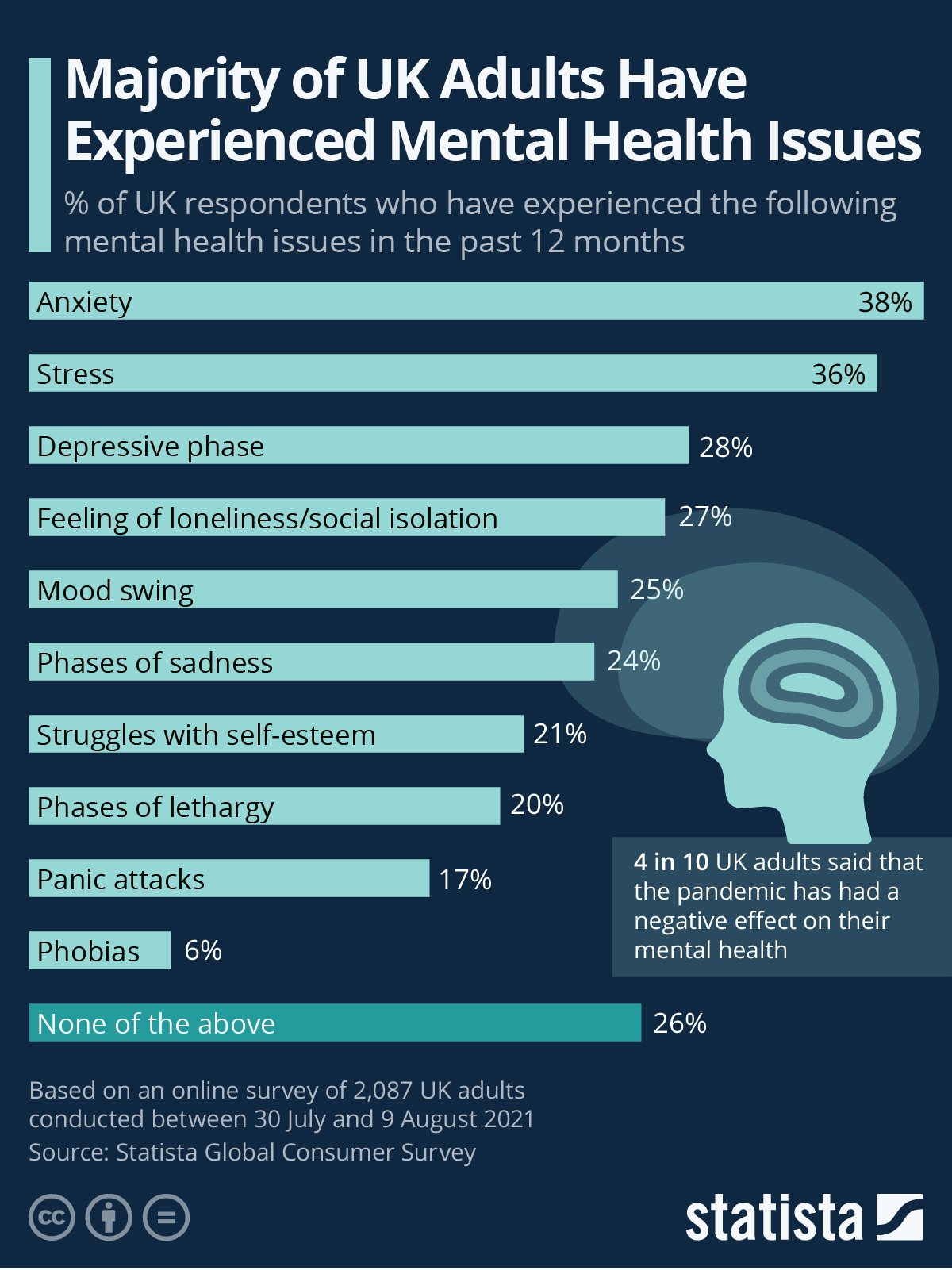
    Infographic: Majority of UK Adults Have Experienced Mental Health Issues | Statista

    So, if you have decided that you want to lead a less anxiety-filled life, what can you do about it? There are basically three main avenues that you can pursue:

    Self-help – there are lots of things that you can do to help yourself, including exercise, mindfulness, taking a positive outlook on life and so on.
    Medication – if you go to your doctor, you may well be prescribed medication to help reduce the anxiety – although the modern trend seems to be to start with therapy first.
    Therapy – there are many types of therapy – hypnotherapy, cognitive behavioural therapy, emotional freedom technique, cuddle therapy and the like.

    I help people who want to reduce their anxiety levels using hypnotherapy. In particular, I concentrate on solution-focused hypnotherapy, which looks at what my clients want to achieve rather than digging up their past. I find that typically within 5 to 10 sessions (see note below), my clients have significantly regained control of themselves and are able to live their lives without the symptoms of the anxiety they used to suffer from.

    Contact me if you want a chat about your anxiety, and what your want to do. If you want hypnotherapy sessions, I work face-to-face out of my clinic in Fleet, Hampshire, and I also work with clients over Zoom.


    Note

    I cannot guarantee success in 5 to 10 sessions – some clients take less than 5 and others take more than 10 – but 5 to 10 is about average.

  • The OCD Cycle

    The OCD Cycle

    My Obsession with Phone Cables

    In the days when we had phones fixed to walls with those twisty cables joining the handset to the phone, I used to feel quite uncomfortable when the twisty cable got twisted round itself in a bit of a tangle. My wife used to laugh at me for taking the phone of the hook and untwisting the cable. It’s not that it gave me any pleasure having a nice neat phone cable, its just that I felt uncomfortable when it was twisted round itself.

    Now, most people I know have some little obsession like that. I had a neighbour who would obsessively wash his car every week – whether or not it needed it. And I know plenty of people who fell they must check their social media accounts as soon as they get up in the morning. You might start to consider, what little obsessions you have.

    As I say to my friends … everyone’s a little bit OCD.

    These little habits we have are not really OCD – because they don’t have a significant impact on our lives. And we actually can stop doing them, even if we don’t want to. It’s when it gets so bad that it starts to interfere with our lives – that’s when we need to do something about it.

    The OCD Cycle

    Diagram showing the OCD cycle, described in the following paragraphs

    OCD stands for Obsessive Compulsive Disorder. The typical pattern for OCD is called the OCD cycle. It often starts off with some sort of trigger – may be a thought, or something that happens around you. That trigger starts off the OCD cycle.

    1. Something triggers an obsessive thought that goes round and round in your head – usually a worry or very negative thought – this is the obsessive part of the cycle.
    2. The negative thinking creates anxiety; which starts to dominate your brain and re-enforces the negative thinking. The anxiety gradually increases.
    3. You feel compelled to take some specific action. If you think about logically, the compulsion will not resolve the situation, but at this point you are not thinking logically – you just want to get rid of the anxiety. This is the compulsive stage.
    4. The compulsion gives you temporary relief. So just for a short time, the anxiety reduces … until the next time.

    A Couple of Examples

    OCD can grow so as to completely dominate people’s lives. Here are some examples I have met (with names changed of course) …

    John’s OCD was triggered when he was due to leave his flat. He worried obsessively about the house being broken into while he was out. This caused him a huge amount of anxiety that took over his logical thinking patterns. He would compulsively go round each room in his flat checking that the windows were closed and locked – shaking each one vigorously, and then when he had finished he would go round and check them all again, just in case he had missed one. This gave him a temporary relief from the anxiety, but when the OCD really kicked in, he would check a third and fourth time, and eventually stopped leaving his flat altogether.

    Jane’s OCD was triggered whenever she ate anything. She worried that the food she ate might have sugar in it and she was certain that any amount of sugar was bad for her. This worry caused her massive anxiety whenever she was about to eat any food. She started checking every label of everything before she ate it – obsessively checking the contents for sugar, and refusing to eat anything that had any sugar – even in trace amounts. Reading all the labels gave here temporary relief from anxiety until she had to eat again. She massively restricted what she would eat, and stopped eating out, or eating anything that anyone else offered her unless she could read the ingredients label first.

    How Do You Know If You Have OCD?

    Many people with OCD do not recognise that they have a problem – it is so much part of their lives that it has become normal. So ask yourself these questions:

    Do you often have worried thoughts going round and round in your head – always worrying about the same thing?
    Do you have a something you do to prevent the thing that you are worrying about from happening?
    Do you feel compelled to do it – with an almost irresistible urge?
    Do other people tell you that what you are doing is over the top?
    Do you notice other people in the same situation doing something other than what you would do?

    What Can You Do About It?

    If you have OCD, or recognise OCD traits in one of your family and friends, you can do something about it. Doctors can prescribe medication – usually SSRI drugs (Selective Serotonin Re-uptake Inhibitors). These are also prescribed for anxiety and depression. The purpose of the SSRI medication is to break the cycle at the anxiety stage. If you can reduce the anxiety, then you may not feel the compulsion.

    The other forms of treatment for OCD are therapy. Cognitive Behavioural Therapy will normally gradually increase your tolerance for the trigger, so that the obsessive thoughts become more in control.

    Hypnotherapy is all about allowing the unconscious part of our brain (sometimes referred to as the subconscious) to find new patterns of behaviour. When you are in a very relaxed frame of mind in a trance, the unconscious part of your mind can rewire itself, and deal with the build up of stress that has occurred and not yet been dealt with. This can allow the brain to find its own way to break the OCD cycle in a very relaxed and calm way.

    Photo by alevision.co on Unsplash

  • All about anxiety?

    All about anxiety?

    This is a brief description of anxiety and why we have it. I do not cover in any detail what to do about it. I will leave that for other posts.

    Signs and Symptoms

    When we experience anxiety, we usually notice a number of signs and symptoms in our body and mind. People will typically notice one or more of the following:

    • An uncomfortable feeling in the chest or stomach
    • Increased muscle tension
    • Increased breathing rate
    • Increased heart rate and blood pressure
    • Increase in adrenaline and cortisol in the body
    • Inability to stop worrying that something bad will happen (overthinking)
    • Inability to stop reminding themselves or re-living something bad that happened in the past
    • Inability to think clearly
    • Increased jumpiness at sudden noises or movements
    • Panic attacks

    Anxiety comes in different degrees – from mild anxiety to full blown panic attacks.

    Anxiety and Excitement

    The feeling of anxiety is similar to the feeling of excitement. This is why some people get excited when they go on a rollercoaster or one of those scary rides, and others get panicky and scared. The body gets a similar reaction in both cases – a burst of adrenaline and cortisol. Some people love it and others hate it.

    What anxiety is for

    Anxiety is basically nature’s way of getting you to focus on potential danger. It is getting ready for the fight-or-flight-or-freeze response to danger. Imagine our ancestors who lived day-to-day by hunting and gathering. If they noticed signs of a pack of dangerous animals hunting in the area, they would become anxious as they went about their daily activities. The anxiety made them focus more of their attention on the possibility that they might be attacked by predators. They would be more aware of noises and movement that they might catch out of the corner of their eyes.

    Their anxiety would increase if the danger was imminent. The brain would focus more on the potential danger than on gathering food. And as the danger lessened, the brain would focus more on gathering food than on the danger. Getting the balance right is key.

    How the brain gets it wrong

    In modern society, in most (but not all) parts of the world, we do not experience life-threatening dangers on a regular basis. But the part of the brain that deals with anxiety (the amygdala) is very primitive, and does not understand the modern world. It is the same brain structure that our hunter-gatherer ancestors had many years ago, and now has to deal with a society that has moved on. So the amygdala sometimes gets it wrong. It creates anxiety when there is no life-threatening event happening around us.

    And what is more, once it learns a pattern, the amygdala tends to stick with it. So if someone starts to get anxious when going into a crowded supermarket, say, the amygdala will attempt to repeat the pattern of anxiety next time they go into a crowded supermarket. This pattern then becomes reinforced. Sometimes we can recognise the triggers that give rise to anxiety, and sometimes we cannot. In some cases anxiety is a constant presence.

    Everyone had moments of anxiety at sometime in their lives. Even the most calm people will feel a twinge of anxiety if they see a car speeding towards them as they start to cross the road. This is normal. But some people suffer from a large amount of anxiety all or most of the time. Their amygdala has somehow learned to become over-sensitive, creating anxiety when it’s not needed.

    Classification of anxiety

    Doctors will classify anxiety disorders, but they are all variations on the same thing. The main classification of anxiety disorders are

    • Generalised anxiety disorder (GAD)
    • Social anxiety disorder (SAD)
    • Panic disorder
    • Obsessive-compulsive disorder (OCD)

    Doing something about it

    There are three main approaches to doing something about anxiety. I am not going to cover these in any detail in this post:

    • Self-help – there is a lot of advice available to help you help yourself – including such things as mindfulness, breathing techniques, distraction techniques and so on
    • Therapies – there are many talking and other therapies that can help
    • Medication – prescribed medication can include anti-anxiety medication and antidepressants (which also help with anxiety)

    As a hypnotherapist – of course, I would recommend hypnotherapy. But I know that hypnotherapy is not for everyone. You need to make your own decisions about what is best for you. The first step is to decide whether or not your anxiety impacts your life sufficiently for you to want to do something about it. The next thing is to recognise that there are things you can do about it – you are not stuck with it forever. It is at this point that you can start to turn it round.

  • An Overview of Anxiety, and what you can do about it

    An Overview of Anxiety, and what you can do about it

    Anxiety means different things to different people. To some it is living with a constant state of tension – always jumping at the slightest noise. Some have runaway thoughts in their mind – constant rumination on the bad things that have happened, or that might happen, or that they imagine are happening.

    For some, their anxiety manifests itself in physical signs such as IBS, acid reflux, migraines, loss of libido, eczema, excessive sweating, nausea. For others, it appears as behaviour that they don’t seem to be able to control – OCD, nail biting, over-eating, drinking in excess, smoking etc.

    Whatever the signs and symptoms that manifest themselves, the sufferer may reach a stage where they decide that they have to do something about it. Everyone has some anxiety in their lives … on occasions. It only becomes a problem when it has a serious negative impact on their lives.

    There are three broad ways that you can tackle anxiety: self-help, medication and therapy. Before I look at these in more detail, please note … some of the physical signs and symptoms of anxiety can also be signs or symptoms of physical problems – so make sure you check with your doctor.

    Self Help

    Most anxiety sufferers start with self-help and there is a wide variety of websites and articles available that will offer suggestions. Some of the key ideas behind these self-help ideas are:

    Use mindfulness techniques to help focus the mind on the here-and-now. This prevents the mind wandering into the realm of negative thinking, and trains the anxiety sufferer to be able to have a calm mind rather than ruminating on potential negative outcomes.

    Exercise and diet are extremely important factors in overcoming anxiety. Exercise generates the right chemicals in your brain and body to provide that feel-good factor. The right diet can cultivate the right bacteria in your body that is now known to have a significant impact on mood.

    Regulating sleep is a key weapon against over-anxiety. The dreaming part of your sleep is the time when your brain sorts out all the unresolved stress. So good sleep hygiene is very important.

    Contact with nature is known to help relieve anxiety – so go for a walk in the woods!

    Cultivating a positive outlook on life – positive thoughts, activities leading to a positive outcome, positive interaction with other people – all help the right chemicals flow in the brain that reduce anxiety.

    Medication

    A medical doctor will sometimes prescribe medication for treating anxiety disorders. This will often be a antidepressant such as one of the SSRI group of drugs (selective serotonin reuptake inhibitor). Although these drugs are called antidepressants, they will also help with anxiety.

    There is a chemical in the brain that travels between the neurones called serotonin. A steady flow of serotonin in the brain produces a general feeling of well-being. However, shortly after serotonin is released, it is reabsorbed, so the brain needs a constant supply.

    SSRI medication slows down the process of reabsorbing serotonin, so it hangs out in your brain for longer. When you are anxious, you generally feel low, so having serotonin hanging round a bit longer can raise your mood and pull you out of the anxiety a little quicker.

    Therapy

    There are a wide varieties of therapies available to help with anxiety.

    Hypnotherapy is an effective way to reduce anxiety. Hypnotherapy focuses on allowing the sub-conscious part of the brain to process unresolved anxiety and stress in the background, without the sufferer really being aware that this is going on. As a hypnotherapist, I strongly support this type of therapy, as I have seen so many of my clients turn their lives around. However, I also recognise that it is not for everybody.

    CBT (Cognitive Behavioural Therapy) is widely recommended. In particular, the NHS (UK’s National Health Service) can prescribe CBT therapy as there is scientific study to demonstrate its effectiveness. However, it does not work with everyone.

    A wide range of other therapies are available, too many to provide a comprehensive list here. As well as talking therapies such as counselling, there are physical therapies such as Havening, Cuddle therapy and EMDR.

    Conclusion

    So if you are suffering from anxiety to the point where it seriously impacts your life, I would recommend you do something about it. If you have physical symptoms – check with your doctor first in case there is a physical cause. Self-help is a good start, but if you need additional help you need to look to therapy or medication. Of course, I would always recommend hypnotherapy, but I do recognise that this is not for everyone, and other therapies are available.